



 GRAND CANYON
Discover the Story Behind Your 3D Print
Thank you for choosing this 3D model of the Grand Canyon. This model features the signature areas of Grand Canyon National Park’s South Rim and North Rim, capturing their defining contours and dramatic elevation contrasts. These locations showcase the canyon’s sweeping views, rugged terrain, and the remarkable story they tell about God’s handiwork in this extraordinary place. These locations reflect the canyon’s beauty, its history, and the deeper story they reveal about God’s creation.
A Glimpse Into History
The South Rim has long been the primary doorway into Grand Canyon National Park. Long before roads and railways reached this high plateau, Native peoples used routes along the rim to hunt, gather, and move between seasonal camps. When American explorers and survey teams arrived in the 1800s, the South Rim quickly became the staging ground for canyon exploration. With the arrival of the Santa Fe Railway in 1901, the quiet rim transformed into a world-famous destination as visitors poured in to see the canyon for themselves. Historic landmarks such as the El Tovar Hotel and Hopi House still stand as reminders of that early era and the remarkable heritage that shaped this side of the canyon.
Across the chasm lies the North Rim—a very different world. Higher in elevation, cooler in temperature, and far more remote, the North Rim draws fewer visitors but offers some of the most striking vistas in the entire park. Early settlers and explorers found this side harder to reach, and even today the limited access keeps it quieter and more rugged. From its forested plateau, visitors look across one of the widest stretches of the canyon, gaining a sweeping perspective of its vastness and grandeur.
Linking the two rims is the legendary corridor system, with the Bright Angel, South Kaibab, and North Kaibab Trails forming the backbone of Grand Canyon exploration. Today these trails guide hikers through the canyon’s striking layers—each a record of the catastrophic processes we understand within the framework of the global Flood described in Scripture. This is the journey we lead guests on during our Rim-to-Rim backpacking adventures—an unforgettable trek that brings the South Rim, the canyon’s inner world, and the North Rim together in a single sweeping experience.
Most modern visitors begin their time on the South Rim at the Grand Canyon Visitor Center. Interactive exhibits, maps, and interpretive displays help guests grasp the canyon’s features and prepare for their time along the rim. It’s also where many of our daily tours begin, as guests meet their Canyon Ministries guide near the flagpole before setting out to explore the canyon’s beauty, history, and the testimony it bears to God’s creation.
Evidence of the Flood
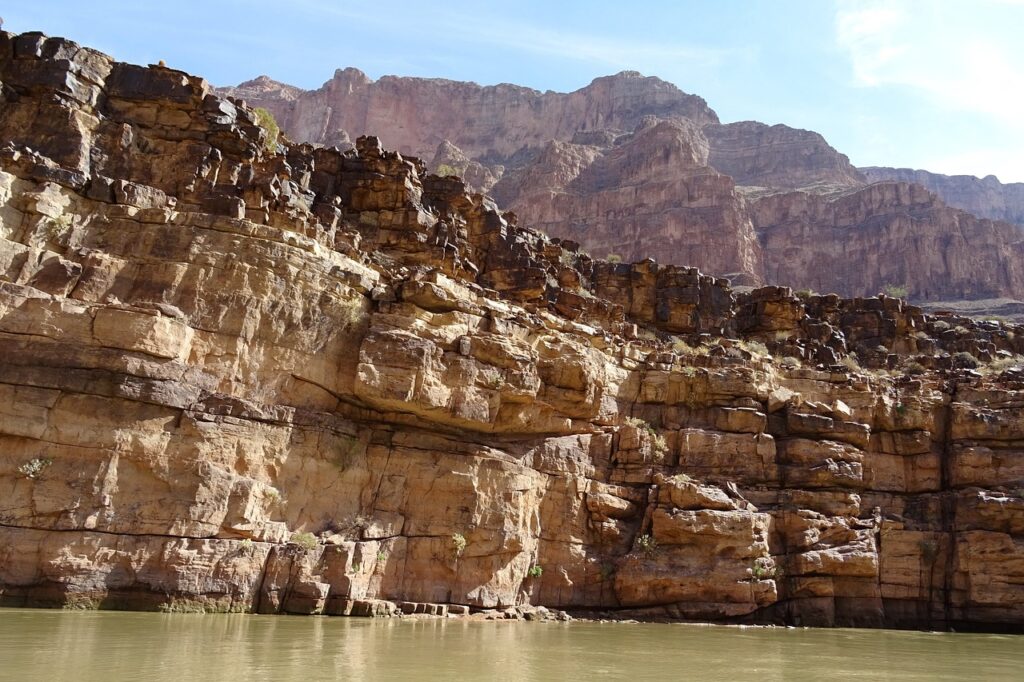
As impressive as the South Rim and North Rim are, their beauty is only part of the story. The Grand Canyon stands as a powerful witness to the global Flood recorded in Genesis—a sudden, world-changing event that shaped Earth’s surface far more rapidly than slow, gradual processes ever could. The canyon’s fossils, sharply defined rock layers, and vast erosional features all point to catastrophic formation on a massive scale.
From the South Rim, visitors look out across one of the most complete and accessible displays of sedimentary rock on Earth. Layer upon layer sits flat and undisturbed, stretching for hundreds of miles in every direction. This type of continuity is exactly what we would expect from rapidly deposited sediments during the Flood. The boundaries between these layers are remarkably sharp, with little evidence of long ages of erosion or soil formation between them—features that challenge the idea of slow accumulation and instead support rapid burial by powerful, sustained water flow.
Across the canyon, the North Rim offers a higher, cooler vantage point with even broader views of this massive layer sequence. From that elevated perch, you can see how the sedimentary units stack like sheets—continuous, uniform, and clearly laid down in quick succession. Fossils found within these layers—many preserved in lifelike detail—also point to sudden burial under catastrophic conditions, not the slow processes imagined in long-age interpretations.
Both rims reveal the same story: a vast, coherent geological record consistent with the Flood. The Tapeats Sandstone near the canyon’s base shows signs of violent, high-energy water deposition, filled with rounded cobbles and coarse material carried and dropped rapidly. Above it, alternating layers of shale, limestone, and sandstone reflect shifting water conditions during the year-long catastrophe.
So when you examine your 3D model, picture what these rims represent—not just viewpoints, but windows into Earth’s past. The Grand Canyon isn’t merely a scenic landmark; it is a testament to God’s power, His judgment in the days of Noah, and the trustworthiness of Scripture from the very first chapter.
Carving of the Canyon
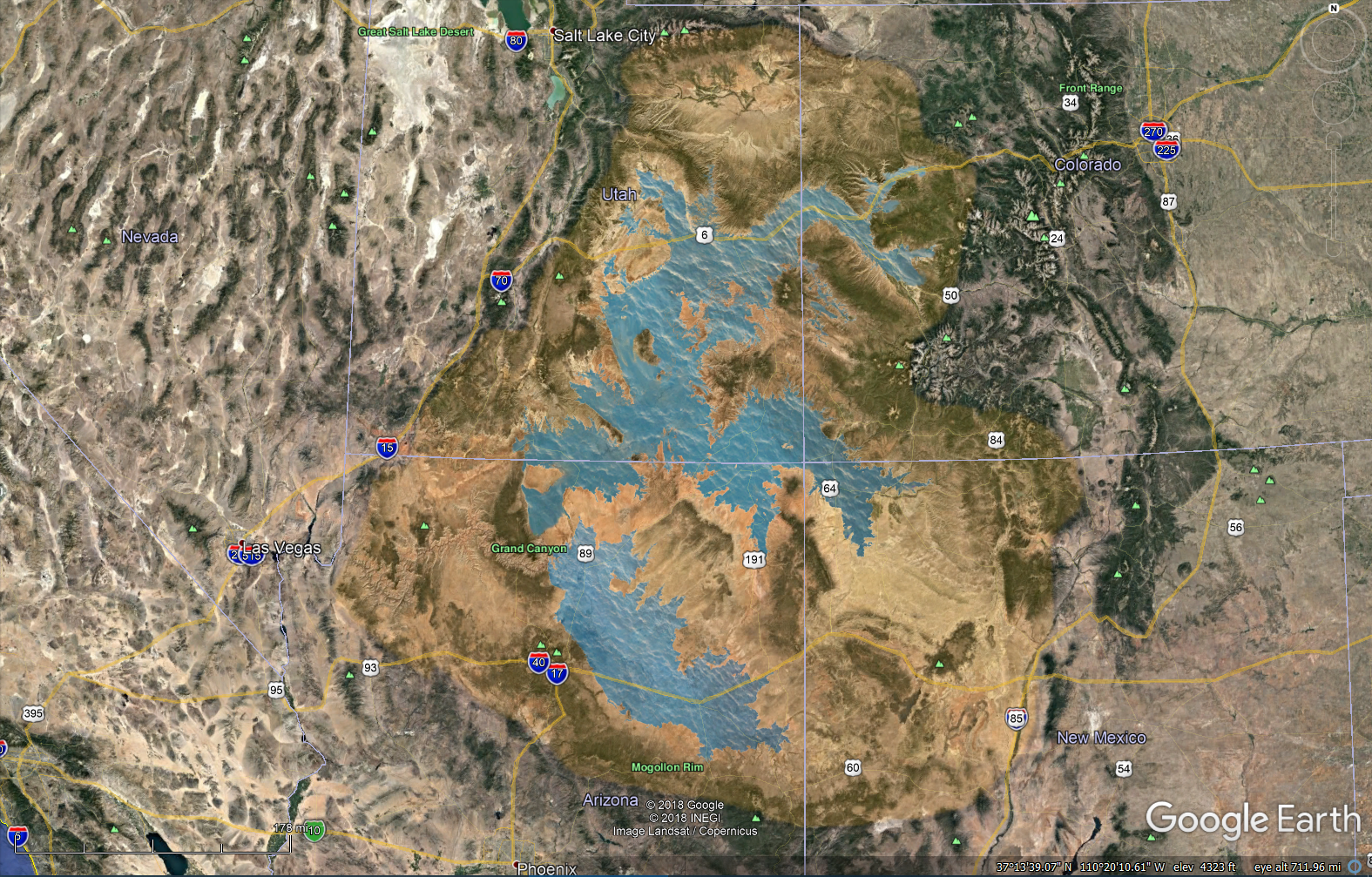
We believe that after the Flood, and likely during the final stages of the Ice Age, the Grand Canyon was rapidly cut through the thick sedimentary layers laid down during that global event. In the centuries following the Flood, enormous lakes—including Canyonlands Lake and Lake Bidahochi (Hopi Lake)—formed on the uplifted, bowl-shaped Colorado Plateau. These lakes were held in place by natural dams of rock and sediment.
At some point, these lakes began to spill across the Kaibab Plateau on the Southwestern bowl rim of the much larger Colorado Plateau. When it breached, unimaginable volumes of water surged off the Colorado Plateau, bursting through the newly deposited rock layers. The resulting outflow of many thousands of cubic miles of water triggered catastrophic, runaway erosion—far beyond anything we see in modern rivers. Instead of slow, gradual carving, the canyon was opened quickly as a massive drainage system, likely in a matter of weeks or months.
What we see on our river trips fits this picture beautifully. The sheer walls, the sharp contact points between layers, and the cleanly sliced corridors show the marks of rapid incision, not slow meandering erosion. The Colorado River today simply follows the course cut by these catastrophic outflows; it did not carve the canyon over long ages. It occupies the path left behind when the floodwaters rushed off the plateau and drained toward the Pacific.
This is why the canyon’s scale, symmetry, and sharply defined features remain unmatched anywhere else on earth—they are the remnants of a world reshaped in the wake of the global Flood. The Grand Canyon stands not as a monument to deep time and uniformitarianism, but as a vivid reminder of God’s power, His judgment, and the reliability of the biblical record.
Your 3D Print: A Story of Significance
Your 3D print is more than a representation of this iconic location—it’s a tangible reminder of the beauty, history, and significance of the Grand Canyon. Whether displayed on a shelf or used as an educational tool, it serves as a conversation starter about the evidence of the Flood and the glory of God’s creation.