



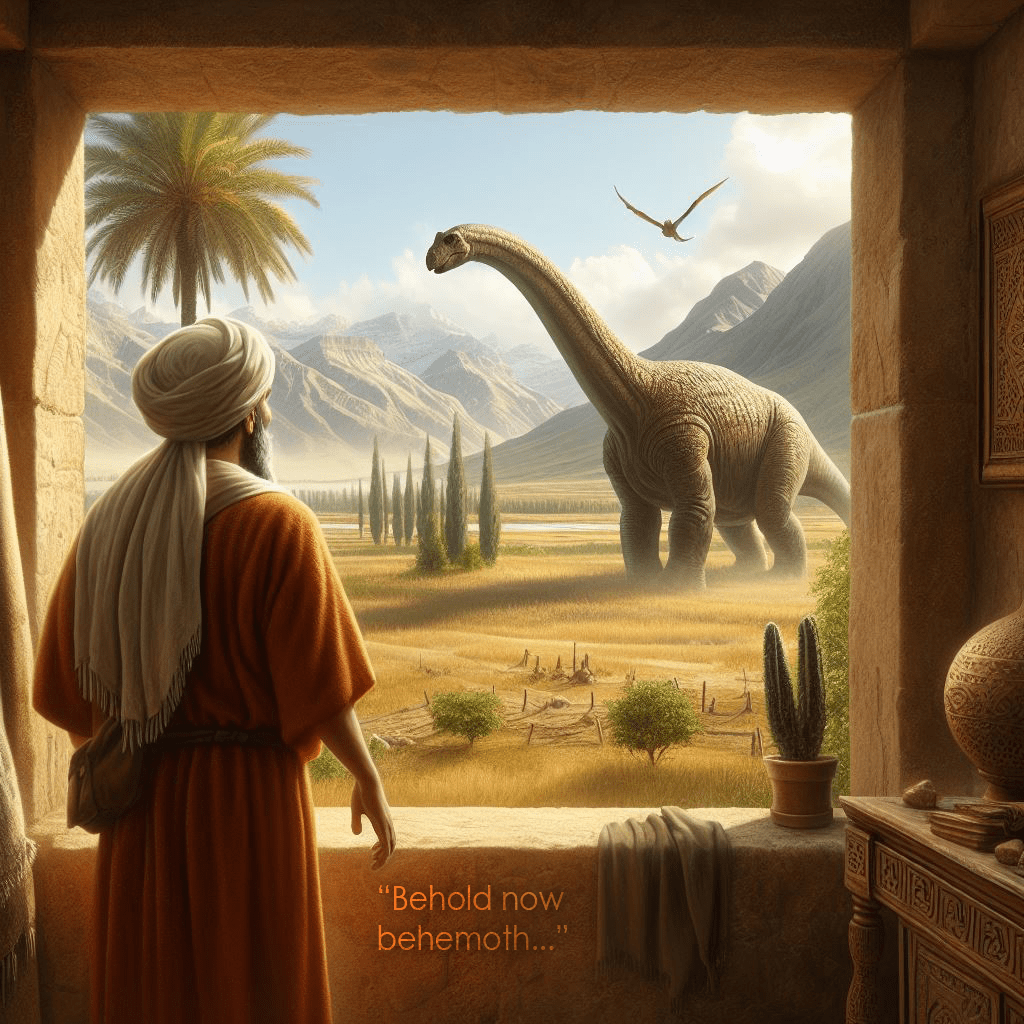
Is Behemoth a Dinosaur in the Bible?
Nate Loper – December 4, 2025
The identity of the mysterious “Behemoth” in Job 40:15–24 has long intrigued scholars and students of Scripture. Many commentaries suggest Behemoth was a hippopotamus or elephant, while others dismiss it as a mythological creature. However, taking the text at face value – and from a young-earth creation (YEC) perspective that humans coexisted with all land animals – there is strong reason to conclude that Behemoth was a real creature best fitting the description of a sauropod dinosaur. In this article, we will examine the biblical description of Behemoth and present arguments supporting its identification as a sauropod and show how the details in Job harmonize with both the biblical record and scientific discoveries. The sauropod hypothesis of Behemoth is not only plausible but compelling, affirming the truth of Scripture and the reality of humans living alongside these magnificent creatures.
“Behold Behemoth”: A Real Creature Alongside Man
Right at the start of God’s description, we find important clues about Behemoth’s reality and timing. God says to Job, “Behold now Behemoth, which I made along with you” (Job 40:15, NKJV). The command to “behold” (Hebrew henna) means “look at” or “take notice of” – implying that Job could actually observe this creature or was at least familiar with it. This is not a hypothetical or mythic beast of a fairy tale; God is pointing Job’s attention to a tangible, living animal in the world Job knew. The words “which I made along with you” speak against the idea that Behemoth is merely a mythical creature. In other words, Behemoth was real, part of the created order just as Job was, not a figment of ancient mythology.
The Hebrew term “Behemoth” (בְּהֵמוֹת) is itself noteworthy. It is the plural form of behemah (“beast” or large animal). Hebrew often uses a plural of majesty or intensification, and here “Behemoth” literally means “beast of beasts” – an extraordinarily great beast. This suggests we are dealing with a superlative creature, the greatest of its kind.
Furthermore, the context of Job 38–41 is crucial. In these chapters, God is challenging Job by highlighting real phenomena and real creatures to demonstrate His power in creation. Prior to Behemoth, God mentions lions, ravens, mountain goats, deer, wild donkeys, wild oxen, ostriches, horses, hawks, and eagles – all familiar, real animals (Job 38:39–41, 39:1–30). After Behemoth, in Job 41, God describes Leviathan (another formidable creature of the sea). Nowhere in this speech does God transition into mythology or fable. The consistent theme is: if Job cannot even control or fully understand these mighty creatures God made, how could he contend with the Creator? The point of God’s argument demands that Behemoth be a real, known creature – otherwise the object lesson would lose its force. It would make little sense for God to tell Job “gird up your loins” (Job 40:7) and then impress him with a make-believe beast. Thus, we conclude that Behemoth was a real terrestrial animal, alive in Job’s day, and in fact one so impressive that God uses it as the supreme example of His creative power.
Importantly, God says He made Behemoth “along with you” (Job 40:15). A proper hermeneutical understanding takes this quite literally – God created humans and the largest land beasts on the same day (Day Six of Creation, per Genesis 1:24–27). Humans and all kinds of land animals (which would include dinosaurs) were contemporaries from the beginning. They coexisted both before the Flood and, in smaller numbers, after the Flood. After Noah’s Flood, representatives of each “kind” of land animal (including dinosaur kinds) came off the Ark (Genesis 8:17–19) and lived alongside mankind until their eventual extinction in later periods. The Book of Job is set in the post-Flood era (likely in the Patriarchal period). Thus Job living at that time could indeed encounter creatures like Behemoth. In fact, many ancient cultures retained memories or records of dinosaur-like creatures (often calling them “dragons”). Artwork and legends from around the world depict giant reptilian beasts, suggesting people were familiar with them in pre-modern times. Even physical evidence, such as unfossilized soft tissue and blood cells found in some dinosaur fossils, hints that these creatures lived not so terribly long ago. All of this corroborates the biblical implication that Behemoth was a real creature contemporary with humans – not a long-extinct beast known only by fossils in Job’s day, nor a mythical construct.
The Chief of God’s Land Creatures
Job 40:19 declares of Behemoth: “He is the first of the ways of God; only He who made him can bring near His sword”. The phrase “first of the ways of God” can be understood as the foremost, or mightiest, of God’s creations in the land-animal category. In other words, Behemoth was the largest and most imposing land creature God had made. Consider: what do we know is the largest land animal to have ever existed (from both the fossil record and historical accounts)? Certainly not the hippo or elephant – impressive as they are, neither would be called “chief of the animals.” The largest elephant on record weighs perhaps 10 tons, and a large bull hippo around 4 tons. But sauropod dinosaurs (the long-necked, long-tailed giants like Apatosaurus, Diplodocus, or Patagotitan) were vastly larger – on the order of 30, 50, even up to 70+ tons, with lengths over 100 feet in some cases. A creature of that magnitude far better fits the idea of “first in rank” among God’s land creatures. Indeed, sauropods are the biggest land animals known to science. It makes sense that God would choose the most colossal land animal as the prime example of His creative might.
Job 40:19 also says, “Let him who made him bring near his sword,” implying only the Creator Himself could hope to subdue this beast. In a way, God is stating that no human hunter could dare attack or kill Behemoth – it was essentially invulnerable to human power. This again supports the notion of an animal far beyond the size and strength of anything humans ordinarily dealt with. Men have hunted elephants and hippos throughout history (with danger, yes, but it has been done). In the ancient world, Egyptian and Mesopotamian hunters did occasionally spear hippos; and elephants were tamed or used in war by various civilizations. So humans could approach those animals with weapons, albeit with difficulty. Yet God emphasizes that for Behemoth, no man can approach with a sword – only God as Creator could approach it. Such language befits a creature so massive and powerful that it simply could not be subdued by people with spears or traps. A sauropod dinosaur of enormous size fits this bill: imagine a 60-ton titanosaur – how could an ancient human armed with a sword or bow ever bring it down? No man would stand a chance. The text even asks rhetorically, “Can anyone capture him when he is on watch, or pierce his nose with a snare?” (Job 40:24). The implied answer is “no.” Behemoth was effectively unassailable by hunters. This detail again makes the hippo/elephant interpretation untenable, since both of those animals, while dangerous, have been captured or killed by man. Behemoth, however, was beyond human control. It was a unique, unparalleled giant – exactly what we’d expect if it were a dinosaur like Brachiosaurus or Diplodocus.
Physical Description: Tail Like a Cedar, Bones of Bronze
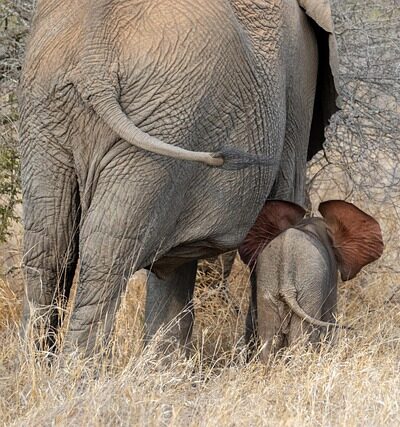 Perhaps the most famous clue about Behemoth’s identity is in Job 40:17: “He moves his tail like a cedar.” This single line has been the crux of much debate. Those who favor the hippo or elephant identification have great difficulty here – because a hippo’s tail is a mere twig (only ~50 cm long) and an elephant’s tail, while longer, is thin and certainly not impressive like a cedar tree. Some scholars uncomfortable with the dinosaur interpretation have even proposed that “tail like a cedar” is a euphemism for the animal’s trunk (in the case of an elephant) or even its reproductive organ. However, the Hebrew word used for “tail” is zanav (זָנָב), which literally means tail (the appendage at the end of the spine) and never refers to a trunk or other body part in Scripture. There is also no precedent for euphemistically calling a hippo’s tail or genitalia a “cedar.” The text plainly means the tail. And it compares that tail to a cedar tree – known for being large, thick, and stately. Cedars (such as the famed cedars of Lebanon) grow to enormous sizes (30–40 meters tall) and are symbols of strength and majesty in the Bible. The imagery suggests that Behemoth’s tail was remarkably large and powerful, swaying like a giant cedar in the wind or standing stiff and strong like a cedar trunk.
No living land animal today has a tail that fits this description – except the great sauropod dinosaurs known from fossils. In fact, if one were to picture the long, thick tail of a diplodocid or titanosaur dinosaur, “like a cedar” is an apt description. The tail of Diplodocus, for instance, was extremely long (over 40 feet) and thick at the base – resembling a tree trunk in size. As the creature walked, that massive tail would swing in a wide arc, swaying like a cedar with each step. Paleontologists have noted that fossilized sauropod trackways rarely show tail drag marks, implying these huge tails were held aloft and moved gracefully, not dragging on the ground. So the dynamically swaying tail of a sauropod matches the cedar metaphor perfectly. In contrast, try applying this to a hippopotamus: its tail is short and thin – incapable of any grand motion. An elephant’s tail, while longer, is comparably skinny and does not evoke a mighty cedar. Clearly, the tail clue rules out hippo or elephant, and strongly favors a sauropod dinosaur as Behemoth.
God also describes Behemoth’s skeletal strength: “Its bones are like beams (tubes) of bronze, its limbs like bars of iron” (Job 40:18). This conveys the idea of massive size and structural strength. Bronze and iron were the hardest metals known to Job’s culture – using them to describe bones and limbs suggests an almost supernaturally tough and large frame. Sauropod dinosaurs again fit well: they had the largest and most robust bones of any land creature. For example, the femur (thigh bone) of some sauropods could be 6–8 feet long and extremely thick. A Patagotitan’s leg bone is literally as large as a steel girder. The comparison to metal beams is apt. Interestingly, many Bible translations render “bones like tubes of bronze,” which hints not only at strength but also hollowness (a tube is hollow). This is fascinating, because sauropod bones, for all their size, were ingeniously lightweight – often filled with air spaces like modern bird bones. Studies show sauropod vertebrae in particular could be up to 90% air by volume, making their huge frames manageable in weight. In effect, a sauropod’s major bones were structured like metal tubes: a hard, dense outer layer with a hollow or spongy interior. The bronze-like “tubular” bones described for Behemoth align with this anatomical design of sauropods. Likewise, “limbs like bars of iron” emphasizes not just size but solidity – and indeed, certain sauropod bones (like the limb girdles, or the ribs) were fully ossified and extremely solid, providing the necessary support for these giants. No living animal’s bones quite compare to the sheer massiveness of a sauropod’s skeletal elements. An elephant’s leg bones are big, but an Argentinosaurus leg bone dwarfs them. Thus, the bone imagery in Job – bronze tubes and iron bars – resonates with the anatomy of a sauropod dinosaur.
Another detail: “What strength he has in his loins, what power in the muscles of his belly!” (Job 40:16). This highlights Behemoth’s core strength – the hips, abdomen, and pelvic region are noted as especially powerful. Again, think of a giant quadrupedal dinosaur: the hip structure of sauropods was immense, supporting the bulk of the body. Paleontologists note that in creatures like Diplodocus, the pelvic girdle was the highest point of the body, and the animal’s center of mass was over the hips. They likely had huge pelvic and abdominal muscles to support the long neck and tail at either end of the body. Indeed, sauropods could possibly rear up on their hind legs, balancing on the strong pillar of their rear limbs and tail – a feat requiring tremendous hip and core strength. No hippo has such a need for strong belly muscles; their strength is more concentrated in jaws or legs. The emphasis on belly/loin strength in Job fits a sauropod’s anatomy, where the abdominal muscles and leg muscles had to carry an enormous weight and allow movement. The muscles and connective tissue around the hips and stomach were critically important in sauropods for walking and even rearing up, underscoring why God would mention those parts when describing Behemoth’s might.
In short, every physical characteristic detailed in Job 40:15–18 finds a satisfying match in a sauropod dinosaur’s features and not in the standard candidates like hippo or elephant. From the cedar-like tail to the iron-like limbs, and the emphasis on a gigantic frame and strength, Behemoth sounds like nothing alive today – but matches something that did exist: the colossal dinosaurs now known only from fossils. As biblical creationists have long argued, the simplest explanation is that Behemoth was indeed one of these now-extinct giants that Job could observe. The only reason many modern scholars hesitate to interpret it this way is due to the reigning assumption (from evolutionary geology) that humans and dinosaurs never coexisted. But if we set aside that assumption and trust the biblical timeline (in which land dinosaurs and humans were created on the same day and survived the Flood together), the description in Job aligns beautifully with an extinct sauropod. In fact, the text is so exact that it seems God accurately describes a sauropod in great detail in Job 40!
“He Eats Grass like an Ox”: Diet and the Grass Debate
Some critics have argued that Behemoth cannot be a dinosaur because Job says it “eats grass like an ox” (Job 40:15b). The logic of this criticism is twofold: (1) if Behemoth were a mythological and fearsome dragon-like monster, why depict it as a peaceful herbivore? and (2) for many years scientists believed that grasses did not exist in the eras when dinosaurs lived, thus dinosaurs could not have eaten grass. Let’s address both points.
First, the phrase “eats grass like an ox” simply identifies Behemoth as a herbivore – a plant-eater – and uses an ox (a type of cattle) as a familiar point of comparison. The wording is a simile: “like an ox”, not literally an ox. This is significant. The text is not saying Behemoth is an ox or even a species of cattle; rather, it’s saying that just as an ox grazes on grass, so Behemoth also feeds on vegetation. The very need to use a comparison (“like an ox”) suggests Behemoth was not an ox or cow. If it were simply a bovine, this description would be trivial (“it eats grass like a grass-eating animal” – a tautology!). Instead, by saying “like an ox,” Scripture informs us that this astonishing creature, despite its fearsome size, was docile in diet – a plant-eater, not a predator or carnivore. This actually strengthens the case that Behemoth was real and not mythic. Ancient Near Eastern mythological beasts are typically ferocious and predatory, but Behemoth is depicted calmly grazing, showing it is part of the natural created order. And notably, all known sauropod dinosaurs are believed to have been herbivores, feeding on plants. So describing Behemoth’s diet in this way is perfectly consistent with a sauropod identity. It is also consistent with the context: God is emphasizing Behemoth’s great size and strength, yet it is not a man-eater or a terrorizer of humans. It’s a gigantic but grass-eating creature – one that Job need not fear as a predator, yet still cannot control due to its sheer bulk. The comparison to an ox simply conveys that Behemoth, like domestic cattle, consumes grass (not meat), highlighting its non-threatening diet despite its overwhelming size. Thus, one should not mistakenly equate Behemoth with a literal ox or other large bovine; the text uses the familiarity of cattle simply to illustrate grazing behavior.
 Second, what about the scientific objection regarding grass? For decades, evolutionary paleontologists thought that grasses evolved late in Earth history – supposedly around the Cenozoic era (after the dinosaurs). According to that view, dinosaurs of the Mesozoic era never saw a blade of grass; their world was dominated by ferns, conifers, and other plants, but no grass. Skeptics thus claimed the Bible was in error to mention Behemoth eating grass “like an ox,” if Behemoth was a dinosaur – since “everyone knows” dinosaurs didn’t graze on grass. However, this criticism has been dramatically overturned by new discoveries. In 2005, researchers in India examined fossilized dinosaur dung (coprolites) from late Cretaceous rock layers. To their astonishment, they found phytoliths (microscopic plant bits) of multiple types of grass within the dinosaur coprolites. At least five distinct grass taxa were identified in the droppings of what was likely a sauropod dinosaur. This was headline-making news because it forced a “rewrite” of the story of dinosaur diets and plant evolution. No longer could scientists say grasses didn’t coexist with dinosaurs – clearly they did, and dinosaurs ate them. As one report put it, this discovery “caught the evolutionary world off-guard” and showed that grasses appeared “much earlier” than previously thought. In fact, it suggests that a variety of grasses were already present and being munched on by sauropods in what evolutionists consider the late Mesozoic. For Bible believers, this came as no surprise. Scripture had it right all along – Behemoth (a dinosaur) “feeds on grass”. In short, the presence of grass in Behemoth’s diet is fully plausible – science eventually caught up to the biblical account, vindicating the text. There is no contradiction in saying a sauropod could eat grass; on the contrary, that’s exactly what at least some sauropods did.
From a creation perspective, we can further contextualize this by considering pre-Flood vs. post-Flood ecology. All dinosaur fossils (including the coprolites examined) are found in sedimentary rock layers that we attribute to the global Flood of Noah’s day. These fossils largely capture the pre-Flood world’s flora and fauna as they were buried catastrophically. It appears that grasses were relatively limited in those pre-Flood ecosystems, which were lush with other vegetation (ferns, gymnosperms, etc.), whereas after the Flood the world’s ecology shifted and grasses became much more widespread. In the conventional geologic column, grass fossils (and pollen) become abundant in what are called Cenozoic layers – which correspond to post-Flood sediments in the creation model. The abundance of grass pollen and plant remains increase dramatically through the Cenozoic, meaning that grasslands proliferated in the period following the Flood. From a biblical view, this makes sense: after the Flood, environments changed and open grasslands emerged to a greater extent than in the pre-Flood world. Therefore, the fact that Behemoth in Job’s time eats grass is exactly what we would expect for a post-Flood sauropod living in an era when grasses and herbs were plentiful on the landscape. There is no inconsistency at all. If anything, the mention of grass in Job 40:15 is a subtle confirmation of the creation/Flood model: it hints that by Job’s day (post-Flood), grasses were common fare for large herbivores – which aligns with the fossil record showing grasses abundant in post-Flood strata. And importantly, it demonstrates that nothing in the Bible’s description of Behemoth contradicts known science. The only tension was due to a faulty scientific assumption that had to be corrected in light of new evidence. Today we know sauropod dinosaurs were grass-eaters, just as Behemoth is said to be.
Habitat and Behavior: A Gentle Giant in a Watery World
Job’s depiction of Behemoth also includes details about its preferred habitat and behavior: “The hills bring it their produce, and all the wild animals play nearby. Under the lotus plants it lies, hidden among the reeds in the marsh. The lotuses conceal it in their shadow; the poplars (willows) by the stream surround it. A raging river does not alarm it; it is secure, though the Jordan should surge against its mouth” (Job 40:20–23, NIV). Let’s unpack this. We see an image of Behemoth as a creature that lounges in a marshy, riverine environment, seeking shade among water-side plants. It is at home in the water up to a point – not a fully aquatic creature, but one that can wade or wallow in shallow waters without trouble. Even if a river floods (“rages”), Behemoth stands unmoved and unafraid, even if the torrent gushes into its mouth. This portrays an animal of such size and strength that a strong current doesn’t sweep it away; it can plant itself in a river and be unperturbed. Again, consider how an elephant or hippo match up, versus a sauropod dinosaur.
A flooding river can indeed pose a threat to most animals – though they live there, even hippos will leave a river if it becomes a violent torrent. But the text says Behemoth is not disturbed even if the Jordan River surges. The Jordan in ancient times (and up until modern regulation) was known to have strong seasonal flows; at flood stage it could be very powerful. For a creature to stand there “secure” while the river rages implies immense size and stability. A full-grown sauropod, standing perhaps 20 feet at the shoulder and weighing 50+ tons, fits this picture well. Such a giant could stand in a surging river and hardly be affected – water rushing around its legs would be like a person standing in a brook. Its chest and head would be well above even a swollen river’s waters. In fact, Job 40:23 says Behemoth is confident “though the Jordan gushes into his mouth” – which is a somewhat humorous way to say even if floodwaters splash into its face, it doesn’t panic. This is consistent with a huge animal. An elephant might also be unfazed by a moderate river, but at flood stage even elephants could be swept or would avoid the current. A sauropod, much taller and heavier, could likely remain unmoved in currents that would send hippos or elephants downstream.
We also note that Behemoth lies under shade plants in the marsh for comfort – “the lotus trees cover him with their shade.” Sauropods, being massive, would have had to eat enormous quantities of vegetation daily (estimates of over 400–500 kg of plant matter a day) and thus would naturally frequent areas of lush plant growth. A riverine marsh with plentiful reeds, water plants, and nearby trees would be an ideal feeding ground for such a herbivore. The “hills bring it produce” (Job 40:20) suggests it ranges onto the land to graze as well – likely stripping foliage from upland plants – but then returns to lie in the cool wet areas during the heat of the day. This actually parallels old speculative reconstructions of sauropods (from early paleontology) that imagined them as swamp-dwellers. Modern science indicates sauropods were well adapted to land, not obligately aquatic. Yet, it wouldn’t be surprising if they did enjoy wallowing in water or mud to cool their massive bodies, much like elephants do today. The Behemoth of Job behaves like a gigantic, semi-aquatic herbivore – which is consistent with how a surviving sauropod might have lived in a post-Flood environment, browsing on land but often lingering in marshes or rivers to support its weight or regulate body temperature. Crucially, nothing in this habitat description conflicts with a sauropod identity. Critics sometimes argue “Behemoth fits a hippo because it’s in water among reeds,” but the text never says Behemoth lives in the water full-time – only that it can lie hidden in the shallow marsh and is untroubled by raging rivers. A hippo’s tail fails the cedar test, and an elephant’s lifestyle doesn’t match the marsh scene; whereas a large dinosaur could plausibly satisfy both the physical description and the environmental preferences noted. In sum, Behemoth is portrayed as a peaceful giant of the wetlands – a perfect depiction of a sauropod dinosaur in the post-Flood world.
Not a Myth, Not a Mere Beast: Countering Alternative Identifications
Let’s summarize the alternative identifications often proposed and why they fall short:
Hippopotamus: Many study Bibles footnote “Behemoth” as possibly a hippopotamus. It’s true hippos are large, herbivorous, and like water. But beyond those generalities, the match fails. The tail is the biggest problem – a hippo’s tail is tiny, nothing like a cedar tree. To get around this, some have fancifully suggested the “tail” was meant figuratively or as a euphemism, which, as discussed, is not supported by the text. Additionally, hippos were well-known to the ancients (common in the Nile); there’s nothing “chief of the works of God” about them. People hunted hippos in antiquity; Egyptians even considered them pests at times. It would be hardly awe-inspiring for God to say, “Look at Behemoth… he’s the greatest of creatures” if Behemoth were just a known river creature that humans could (and did) harpoon. The overall bodily description supersedes any normal creature, ruling out any living animal we know – especially a 4-ton hippo. In short, the hippo does not fit the totality of Job’s description, and even some Old Testament scholars who reject a dinosaur view admit the hippo interpretation is weak.
Elephant: This is the other common suggestion. Elephants have larger tails than hippos, but still nothing one would liken to a cedar. Some have argued the “tail” could be the elephant’s trunk – but, again, the Hebrew word is not used that way, and an elephant’s trunk is prehensile, not something described as swaying like a tree. Elephants also, while huge to us, are nowhere near the “first of God’s works” if one considers all creatures; they are much smaller than the largest dinosaurs were. And humans have tamed and utilized elephants; they are not beyond human control (“pierce its nose” calls to mind how elephants can be led by placing rings in their nose or controlling their trunk – something done in ancient India).
“Mythical Chaos Beast”: Some liberal scholars, unwilling to see Behemoth as a real species, claim it represents a mythic cosmic beast of chaos, paired with Leviathan as symbols. But as we covered, the text itself undermines this view. God explicitly says “Behemoth, which I made as I made you,” underscoring that both man and this creature are part of God’s actual creation. The description is grounded in nature: eating grass, lying in marshes, etc. Unlike the ferocious, otherworldly monsters of pagan myth, Behemoth is an herbivore at peace in its habitat. The whole thrust of Job 40–41 is comparative – God uses real creatures to make His point. It would be incongruous for Behemoth to be pure fantasy when every other referent in the divine speeches is real. Behemoth is not presented as a symbol or myth but as an example from creation, as confirmed by the natural details given.
Oxen/Cattle: A few might wonder if “he eats grass like an ox” implies Behemoth was an ox or cattle. But the structure of the sentence itself refutes that: it’s clearly a comparison (“like an ox”), indicating that Behemoth is different from an ox. Also, the Hebrew word for ox (בָּקָר, baqar) is used – if the author meant Behemoth was literally a bovine, there’d be no need to call it “Behemoth” at all. The whole description sets Behemoth apart as unique. So equating it with a mere farm animal doesn’t fit. The phrase is highlighting that despite Behemoth’s fearsome size, it is vegetarian – just as oxen are. And interestingly, this further distances Behemoth from carnivorous “dragon” legends; it’s a subtle clue that we are dealing with a real herbivore, not a myth. In summary, Behemoth is like an ox in diet, but clearly not an ox in identity – it is something far greater.
Given these points, the only viable interpretation left is that Behemoth refers to a real, now-extinct creature, one that was known to Job and matches the attributes described. The sauropod dinosaur model meets all the criteria extremely well. It explains the colossal size (“first of God’s works”), the cedar-like tail, the herbivorous diet, the immense bones, the marsh-loving behavior, and the invincibility to human attack. It even fits with the timeline of Job’s life in the biblical framework – Job likely lived a few centuries after the Flood, during a time when remnant populations of dinosaurs (from those that survived on the Ark) could still roam in secluded areas. We have historical hints and fossil evidence that dinosaurs lived into relatively recent times by standard reckoning: for example, dragon legends, artwork that resembles dinosaurs, and the aforementioned soft tissue finds all support the notion that humans did encounter dinosaurs in the past. So, interpreting Behemoth as a sauropod is not only textually sound but also culturally and scientifically plausible in the YEC view. The only substantial barrier to this interpretation has been the a priori assumption that the Bible’s history is wrong on the coexistence of man and dinosaurs. Remove that bias, and the pieces fall into place neatly.
Persuading the Skeptics: Why It Matters
At this point, one might ask, “Why does identifying Behemoth as a sauropod dinosaur matter? Isn’t it a secondary issue?” In one sense, the exact species of Behemoth is not a doctrine to divide over. But the interpretation of Behemoth becomes a test case for how we handle Scripture versus external assumptions. If the text of Job provides a coherent description that matches a real creature (albeit one we moderns didn’t initially expect), are we willing to take the text seriously? Or do we force it to fit into the mold of current scientific bias (which said “dinosaurs and man never met”)? Many biblical commentators have dismissed the dinosaur identification as “preposterous” on the grounds that the human author of Job could have no knowledge of dinosaurs. Yet, that dismissiveness stems from the belief that dinosaurs died 66 million years before man – a belief grounded in evolutionary timelines, not in Scripture. If one accepts the biblical creation account and global Flood, there is no problem whatsoever with Job knowing of a dinosaur-like creature. As we’ve shown, the description of Behemoth actually drives us to conclude it was an extraordinary extinct beast. So the resistance to this idea often reveals an underlying commitment to secular chronology over biblical history. YEC scholars point out that rejecting the clear implications of the text in favor of “what science says” can be a slippery slope. After all, most scientists also reject other biblical events (like the Resurrection or the Virgin Birth) as impossible, yet as Christians we don’t reinterpret those – we trust God’s Word over human opinion. Likewise, with Behemoth, the safer route is to trust the biblical context and description, which strongly indicate a real monstrous creature in Job’s world – perfectly compatible with a dinosaur.
 Furthermore, embracing the truth of humans living alongside dinosaurs can embolden our confidence in Scripture’s accuracy. For too long, many have scoffed at the idea of “dinosaurs in the Bible,” imagining it to be the stuff of children’s fairy tales. But when we carefully examine the text, we find that the Bible did record just such creatures – not by modern name, but by description. This realization can excite believers to see that the Bible is not at odds with the physical evidence in the world; rather, it can shed light on it. The fossil evidence of dinosaurs, from a Flood perspective, and the textual evidence of Job, from an eyewitness perspective, together tell a consistent story: humans saw these amazing animals. Indeed, ancient people did not use the word “dinosaur” (a modern coinage from 1841 by Sir Richard Owen of London’s Natural History Museum), but they used terms like “dragon” or specific names like “behemoth”. How eye-opening to consider that the Bible contains an actual description of a dinosaur in Job’s own vocabulary!
Lastly, identifying Behemoth as a sauropod also glorifies God by highlighting the majesty of His creation. God intended to show Job something astonishing – a creature of such size and power that Job would recognize his own smallness and God’s greatness. A lumbering 70-ton sauropod accomplishes that purpose far more effectively than a familiar hippo wallowing in the mud. “Behemoth” stands as a testament to the might of the Creator, who made even the largest land animal as easily as He made Job. When we understand Behemoth correctly, we join Job in marveling at God’s works. As Job 40:19 says, “He is the foremost of God’s works”, and truly in terms of terrestrial beasts, a sauropod would be foremost. How great is the God who crafted such a giant! And yet, that same God can approach it with His sword – meaning He has complete mastery over it – whereas we humans are humbled before it. The lesson to Job, and to us, is clear: if we cannot hope to tame Behemoth, we certainly cannot contend with Almighty God. Recognizing Behemoth as a real dinosaur actually amplifies this lesson, because it takes it out of the realm of fantasy and into reality. Job could look at Behemoth and be struck with awe – and we, understanding what Behemoth likely was, can also be struck with awe at both the creature and its Maker.
Let’s Wrap it up—From Head to Tail
A thorough analysis of Job 40:15–24 strongly supports the interpretation that Behemoth was a sauropod dinosaur, or at least a similar gigantic herbivorous creature now extinct. We have seen how the biblical text gives a coherent, literal description that matches known attributes of sauropods: an enormous land animal, created alongside humans, feeding on plants, with a tail likened to a mighty cedar tree, bones like metal beams, unparalleled in strength, at home in marshy habitats, and far beyond the power of man to subdue. Alternative identifications (hippo, elephant, bovine, myth) simply do not account for all the details, whereas the dinosaur identification does – and in fact, it has been affirmed by modern discoveries such as grass found in sauropod coprolites. Rather than viewing the idea as fanciful, we should recognize that it is a straightforward reading of the text in light of a biblical worldview of history. When God says “Behold, Behemoth,” we have taken a fresh look, and what we “see” is essentially a dinosaur on the pages of Scripture – a living, breathing creature that testified to God’s creative genius in Job’s time.
This interpretation not only resolves the mystery of Behemoth’s identity, but it reinforces the reliability of the Bible. It shows that we do not need to twist Scripture to fit secular timelines; instead, we can trust God’s Word, which in this case was millennia ahead of human science (recording details like a dinosaur eating grass that scientists initially laughed at, but later confirmed). It also provides a meaningful connection between the biblical record and the fossil record: the Flood formed the dinosaur fossils, yet some dinosaurs lived on for a time after the Flood, allowing Job (or those in his era) to witness them. Behemoth was one of these survivors, a colossal “king of the land animals” that left a strong impression on all who saw it – an impression God harnessed to teach about His own kingship over creation.
As believers committed to the authority of Scripture, we can confidently assert that Behemoth was real, not a myth, and the most fitting real creature that matches God’s description is a sauropod dinosaur. Far from being “preposterous,” this view arises from careful exegesis and a consistent creation model. It encourages us to stand in awe of God’s works. Next time someone asks, “Are dinosaurs in the Bible?”, we can point to Job 40 and say yes – by the name Behemoth. This magnificent creature once thundered across the Earth, and Job was told to contemplate it as a demonstration of God’s power. We too, in our imagination informed by both Scripture and science, can contemplate Behemoth the sauropod and be moved to worship the One who made such a marvel “along with” us humans. The saga of Behemoth ultimately directs our eyes to the Behemoth’s Creator – and that was precisely God’s intention in the book of Job.
Sources:
- Holy Bible, Job 40:15–24 (primary text for description of Behemoth).
- Konkel, A. H., Cornerstone Biblical Commentary: Job, on Job 40:15 (notes on “which I made as I made you” refuting myth interpretation).
- Answers in Genesis, “Scholars and the Mystery of Behemoth” – overview of Behemoth’s identity and description. https://answersingenesis.org/dinosaurs/scholars-mystery-of-behemoth/
- Genesis Apologetics, “Behemoth in Job 40: Was it a Dinosaur?” – analysis aligning Job’s Behemoth with sauropod anatomy. https://genesisapologetics.com/faq/behemoth-in-job-40-was-it-a-dinosaur
- Biblical Science Institute (Dr. Jason Lisle), “Dinosaurs – Part 2” – discussion of Behemoth as sauropod, noting coprolite evidence of grass in sauropod diet. https://biblicalscienceinstitute.com/origins/dinosaurs-part-2/
- Creation Truth Foundation, “New Fossil – Behemoth Coprolite!” – report on 2005 discovery of grasses in sauropod dung confirming that dinosaurs ate grass. https://www.creationtruth.com/new-fossil-behemoth-coprolite
- Institute for Creation Research, “Pollen Fossils Warp Evolutionary Time” – mentions grass found with sauropod fossils and notes on Behemoth’s diet matching that find. https://www.icr.org/article/7836/
- The University of Chicago Press Journals “Cenozoic Expansion of Grasslands and Climatic Cooling” – noting the rise of grassland ecosystems in the post-dinosaur (Cenozoic) period. https://www.journals.uchicago.edu/doi/10.1086/320791


