


Petrified Forest: Beauty, Mystery, and Catastrophic History
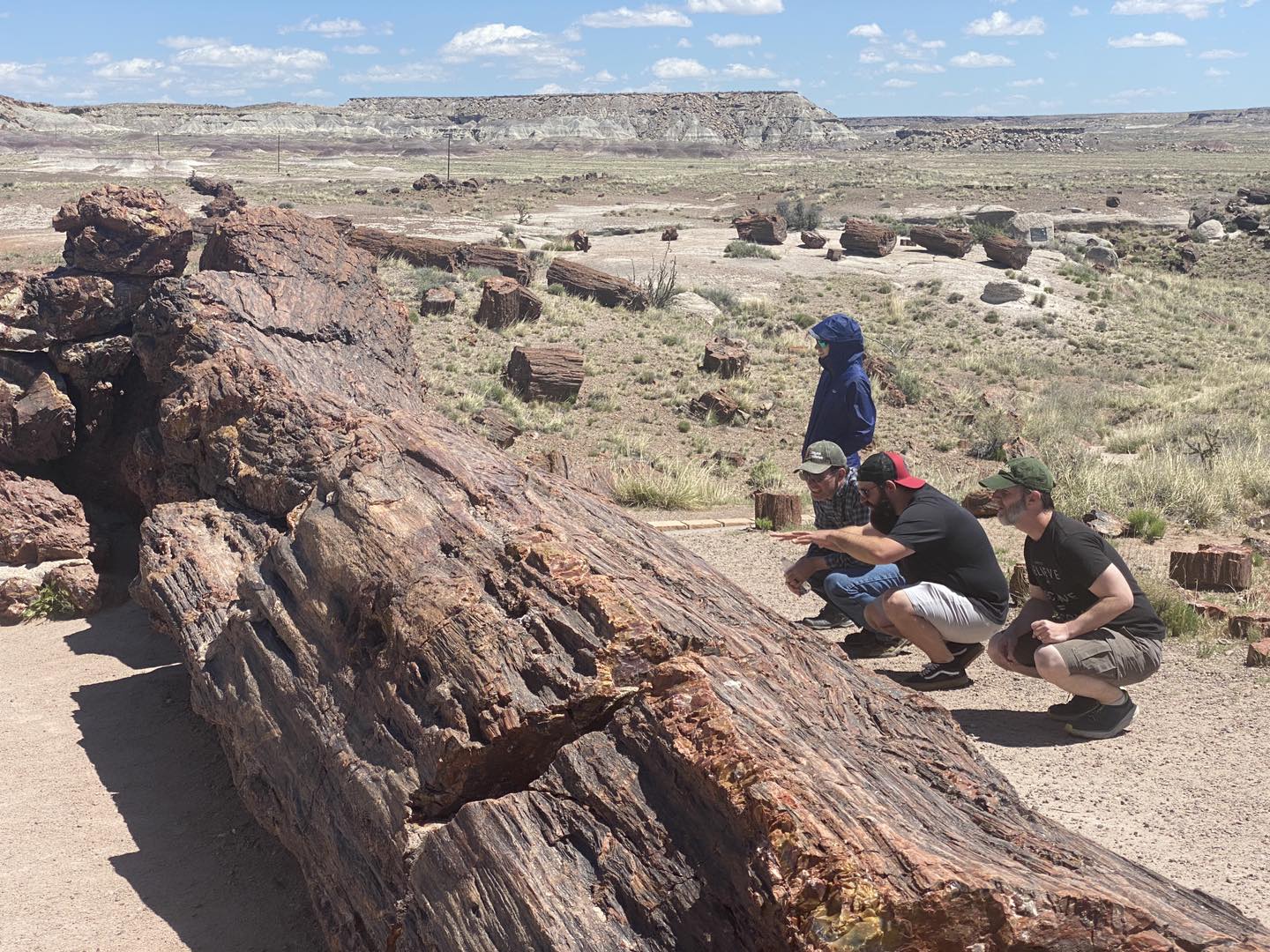
The splendor and importance of this fossilized arbor is hard to overstate. But how did it get here?
Arizona’s Ultimate Rock Garden: The Petrified Forest
Roughly two hours down I-40 East from Flagstaff, or about fifty miles before you reach the New Mexico border, you’ll find one of Northern Arizona’s true gems—the beautiful mystery of Petrified Forest National Park. In 1906, when the passing of the Antiquities Act first gave U.S. Presidents the power to create National Monuments, Petrified Forest became one of Arizona’s very first landmarks to receive that designation. It would take another two years before even the Grand Canyon was afforded that protection! (Of course, Grand Canyon was promoted to a full-blown National Park a mere decade later in 1919, while Petrified Forest had to wait until 1962 for that honor.)
The landscape is dotted with the ancient remains of Native American pueblos and rock art, testifying that we are far from the first to enjoy its beauty and marvel at its secrets. It became a tourist stop by railroad in the 1880s and is also the only National Park to contain a portion of the original Route 66. It now sits right on today’s Interstate 40, where roughly 600,000 visitors drive out to see it each year. It seems people in every era have desired access to this incredible natural wonder. While the rainbow rock layers of the Painted Desert and the mineralized bones of giant reptiles add to its grand mystique, the name of the park suggests its real draw: the vast collection of gigantic and stunningly petrified ancient trees that adorn the whole region. The splendor and importance of this fossilized arbor is hard to overstate. But how did it get here?
How Petrified Wood Forms
To understand the origin of the Petrified Forest, it is important to grasp the basics of how petrified wood forms. Petrified wood is a type of fossil. Wood “petrifies” when specific minerals (most often silica) seep into the wood and either replace the organic compounds in the wood, fill in the gaps between the wood’s structures (making a sort of mineral cast of the wood), or both. For this to happen, the wood must be both protected from decay and exposed to the minerals in such a way that they penetrate deep within the wood’s porous structure. This requires:
- An oxygen-free environment
- The presence of water with the right minerals dissolved in it.
The most common source of silica and other appropriate minerals is from volcanic eruptions, which can also be what buries the trees. While other organic objects can petrify, wood is especially suited to the process because it is more resistant to rotting and is specifically designed for water to flow through it carrying dissolved nutrients. When the tree is alive, its cell walls form a plumbing system to draw water up from the soil through the trunk and branches to even the highest leaves.
 As the silica-rich water seeps through the dead log, these cell walls are often the first thing the minerals replace. This is why some petrified wood still preserves the vivid details of the original tree down to the tiniest grain, so much so that you may not be able to tell the difference between wood and fossil without touching it! Along many of the trails in Petrified Forest National Park, the shattered bits of fossil trees look exactly like fresh mulch. In other cases, trace metals and quartz crystals transform the former tree into a vibrant array of new colors and textures, giving rise to favorite stops in the park like “Rainbow Forest” and “Crystal Forest.”
Once the minerals have replaced much of the tree’s cellular structure and filled in its empty spaces, any remaining organic material either decomposes or remains trapped and preserved in its crystal prison.
A Petrified Forest?
Alright, so the term “forest” might be a little misleading. After all, none of the trees are standing up. They are quite numerous, but not so plentiful as to look like a densely wooded area. Still, we are talking about a lot of large trees petrified in the same vicinity. It is relatively easy to imagine how a volcanic eruption (or a local flood or mudslide in a previously volcanic region) might knock over and deeply bury a tree or two in a silica-rich environment. But a petrified forest, even u…[truncat…[truncated]
