




The Names Are Useful: The Geologic Column
Part 2 of our series examining where biblical creation and conventional geology agree on the evidence, where the interpretation begins to differ, and why.
Spend enough time at the Grand Canyon and you begin to speak a language that sounds strange almost anywhere else. Kaibab. Coconino. Hermit. Supai. Redwall. Muav. Bright Angel. Tapeats. We use those names constantly because they help us identify where we are in the canyon walls and what kind of rock we are looking at.
Alongside those formation names are another set of familiar geological terms. The Kaibab and Coconino are commonly classified as Permian. The Redwall is Mississippian. The Tapeats and Bright Angel are Cambrian. Beneath them are rocks grouped under the much broader term Precambrian.
We use those terms too.
That sometimes surprises people. If Canyon Ministries understands earth history within a biblical chronology measured in thousands rather than billions of years, why use terminology that appears throughout a conventional geologic time chart?
The answer is simple. We are looking at the same rocks, so it makes sense to use the same language when identifying them. The disagreement begins when those names are assumed to settle the question of age.
A Name Can Tell Us Where We Are
Geology depends on classification. If I point toward the pale cliff near the rim and call it the Coconino Sandstone, another geologist knows which rock unit I mean. If we talk about the Redwall Limestone farther down in the canyon, we can compare its fossils, composition, sedimentary structures, thickness, and geographic extent with exposures somewhere else.
Those names allow us to communicate clearly.
The Grand Canyon contains a recognizable sequence of formations, groups, members, and other named stratigraphic units. The familiar Paleozoic sequence progresses through formations such as the Tapeats Sandstone, Bright Angel Formation, Muav Formation, Redwall Limestone, Supai Group, Hermit Formation, Coconino Sandstone, Toroweap Formation, and Kaibab Formation. The National Park Service uses these same formation names when describing the canyon’s geology.

The rock units are observable. Their positions are observable. Their lithology can be examined. Their fossils can be studied. Their contacts can be mapped. Their thickness and geographic extent can be measured.
Naming what we observe is not the same thing as agreeing about how long ago it formed.
That distinction becomes especially important when we move from names such as Coconino Sandstone or Redwall Limestone to terms such as Cambrian, Mississippian, and Permian.
The Same Rock Sequence, Different Timescales
When geologists identify a formation or place a group of rocks within a larger stratigraphic sequence, they are talking about something that can be observed and compared. The Coconino Sandstone is a recognizable body of rock. The Redwall Limestone is another. Their position above or below neighboring formations can be mapped, traced, and discussed whether or not everyone agrees on how much time those rocks represent.
This is why we can refer to the same package or sequence of rocks while disagreeing about the chronology assigned to it. A biblical creation perspective does not require a different Coconino, a different Redwall, or a different Tapeats. We are identifying the same formations and the same order in the canyon wall.
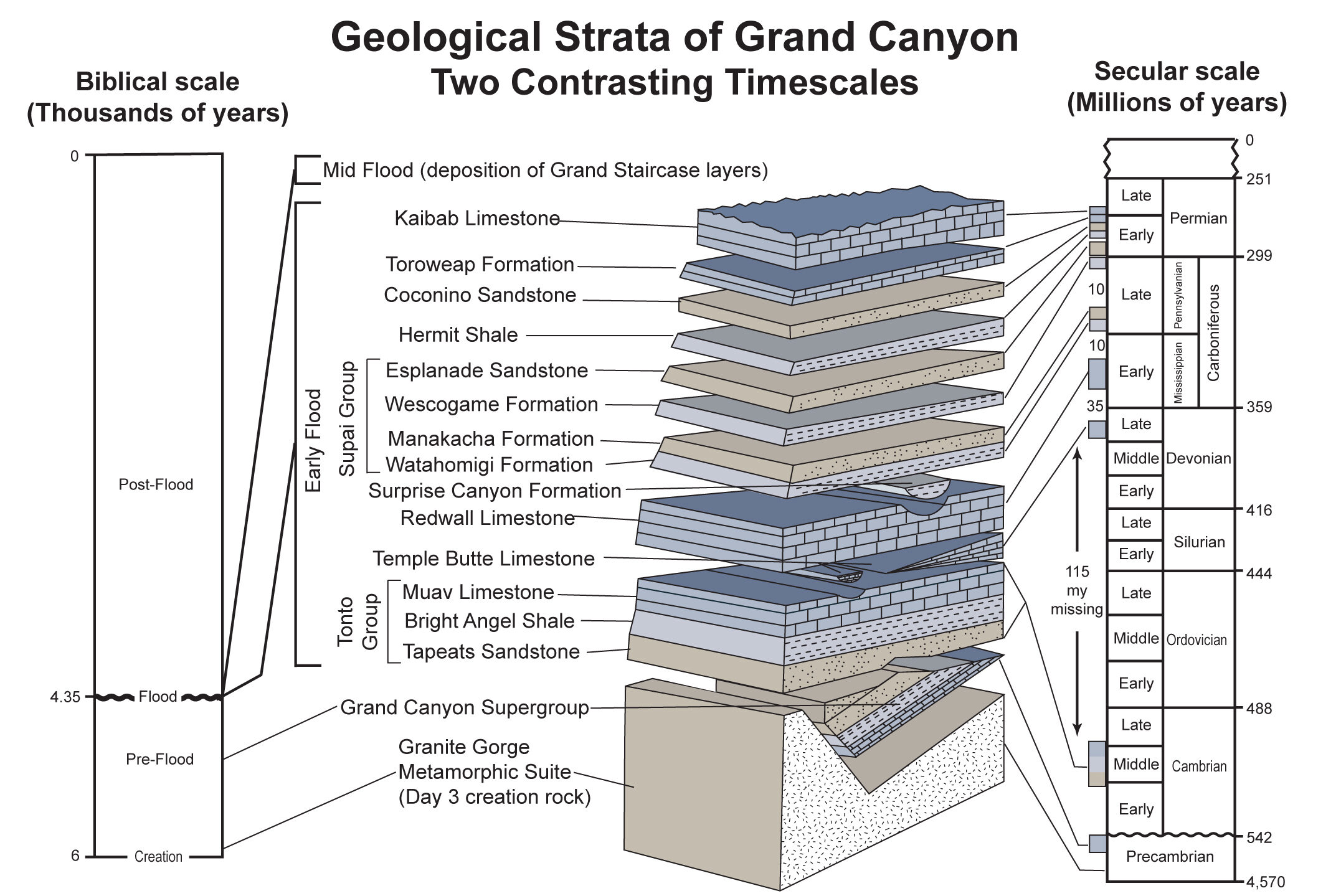
Terms such as Cambrian, Mississippian, and Permian go one step further because, in conventional geology, they are tied to the standard geologic timescale. Calling the Coconino Permian, for example, places it within a particular part of that framework. The International Commission on Stratigraphy formally connects those divisions of rock with divisions of geologic time.
We can still use those terms as a common reference for where a rock package sits in the accepted stratigraphic sequence without agreeing that the sequence represents the conventional numerical ages attached to it. The rocks, their order, and their correlations can be shared observations even when the amount of time assigned to them is not.
Two Timescales, One Grand Canyon
This diagram places the conventional geologic timescale alongside a biblical Flood framework for the Grand Canyon, showing how the same rock sequence can be organized using the same geological names while being interpreted within very different histories and timescales.
Relative Order Is Real
Hike from the South Rim down toward the Colorado River and there is no question that some rocks occur beneath others.
The Tapeats lies low in the Paleozoic sequence. The Bright Angel lies above it. The Redwall is higher still. The Supai, Hermit, Coconino, Toroweap, and Kaibab continue upward toward the rim.
That relative order matters.
If one deposit consistently lies beneath another across a broad area, then, barring later structural complications such as faulting or overturning, the lower deposit was there first. Geologists call this the principle of superposition, and it is one of the simplest and most useful concepts in stratigraphy.
Biblical creation has no reason to reject it.
Order tells us sequence. It does not, by itself, tell us duration.
If two layers of sediment are deposited during the same flood, one can still lie above the other. Their order is real. The lower one came first. But position alone does not tell us whether an hour, a thousand years, or ten million years separated them.
To determine elapsed time, something else must be added to the interpretation.
The Geologic Column Is a Useful Framework
Sometimes conversations about earth history drift into an unnecessary argument over whether the geologic column itself is real. That is not a very useful place to begin.
No single location contains every formation, fossil assemblage, and sedimentary unit represented on a complete geologic chart. The Grand Canyon certainly does not. There are major portions of the standard sequence that are not preserved there. Geologists build the larger framework by comparing rock relationships from one region to another, tracing units laterally, examining fossils and sedimentary characteristics, and correlating those observations across broad areas.
That framework is useful.
The broad stratigraphic succession can be recognized without accepting the conventional timescale used to interpret it.
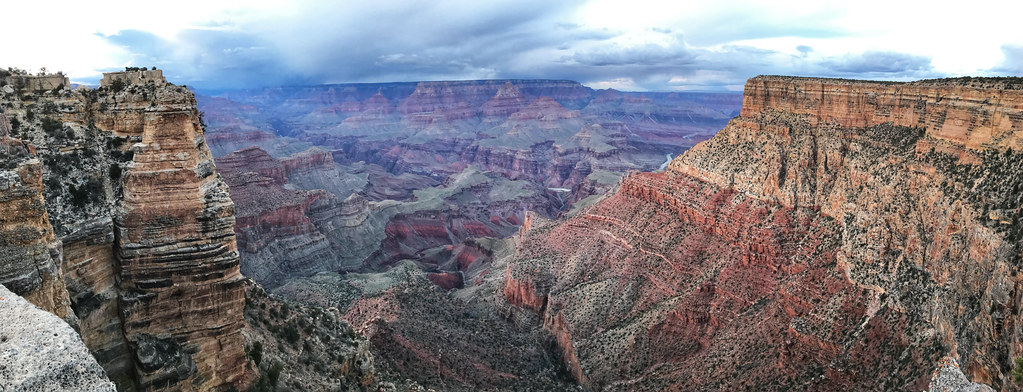
At Grand Canyon, for example, the exposed rocks can be grouped into the crystalline basement, the tilted rocks of the Grand Canyon Supergroup, and the overlying sedimentary sequence. Within those larger packages are numerous formations and members that can be mapped and compared from place to place.
Conventional geology interprets that succession within hundreds of millions of years of earth history. From a biblical creation perspective, much of the fossil-bearing sedimentary sequence is instead understood within the catastrophic events of the global Flood.
The rock sequence itself does not disappear because the historical interpretation changes.
Why Keep the Conventional Names?
Because inventing a separate geological vocabulary would make communication harder without adding anything useful.
If we renamed every standard geological division simply because we disagree with the conventional age assigned to it, reading geological maps and technical papers would quickly become confusing. We would need one vocabulary for an NPS report, another for academic literature, and another for teaching from a biblical creation perspective.
There is no need for that.
If a paper describes a fossil from Cambrian strata, we know approximately where in the standard stratigraphic succession the authors are placing it. If a geologic map identifies a Permian formation, we know how that unit is being correlated with rocks elsewhere. If someone tells me we are standing on the Kaibab Formation at the South Rim, I do not need a second name for it before I can discuss its geology.
Shared terminology gives us a common starting point without requiring a common interpretation of earth history.
What Do We Mean by Precambrian?
The term Precambrian is a good example of how the same geological language can describe the same rocks even when the history assigned to them is very different.
At the Grand Canyon, it refers to the rocks beneath the Cambrian Tapeats Sandstone, including the crystalline basement and the tilted sedimentary rocks of the Grand Canyon Supergroup. Conventional geology recognizes a major break between these rocks and the overlying Cambrian sequence, and so do we. The difference is not only in the character and arrangement of the rocks. With the Cambrian also comes the sudden and widespread appearance of the major fossil record itself, with abundant remains representing many of the major animal groups found around the world.
From a biblical creation perspective, this transition is not best understood as an explosion of life suddenly appearing. It marks the beginning of a massive record of death and burial associated with the global Flood. In most Flood geology models, the Precambrian rocks at the Grand Canyon are therefore understood as pre-Flood. The crystalline basement is commonly associated with creation week, including the events of Day Three, while the Grand Canyon Supergroup records sedimentary and volcanic activity in the pre-Flood world between creation and the onset of the Flood.
That is why we can use the term Precambrian without accepting the conventional numerical ages attached to it. The term identifies a real and recognizable part of the stratigraphic succession. Both models recognize a major transition at the base of the Cambrian. They differ over what that transition represents in earth history.
The same principle applies upward through the canyon. Calling the Tapeats Cambrian, the Redwall Mississippian, or the Coconino Permian helps identify where those units fit within a widely understood system of correlation. The terminology is useful even when the chronology remains disputed.
Geological terminology also changes. The term Tertiary, for example, is common in older literature, while modern international charts divide most of that interval into the Paleogene and Neogene. Classification systems are tools, and the names can change even while the rocks remain the same.
Reading the Same Canyon
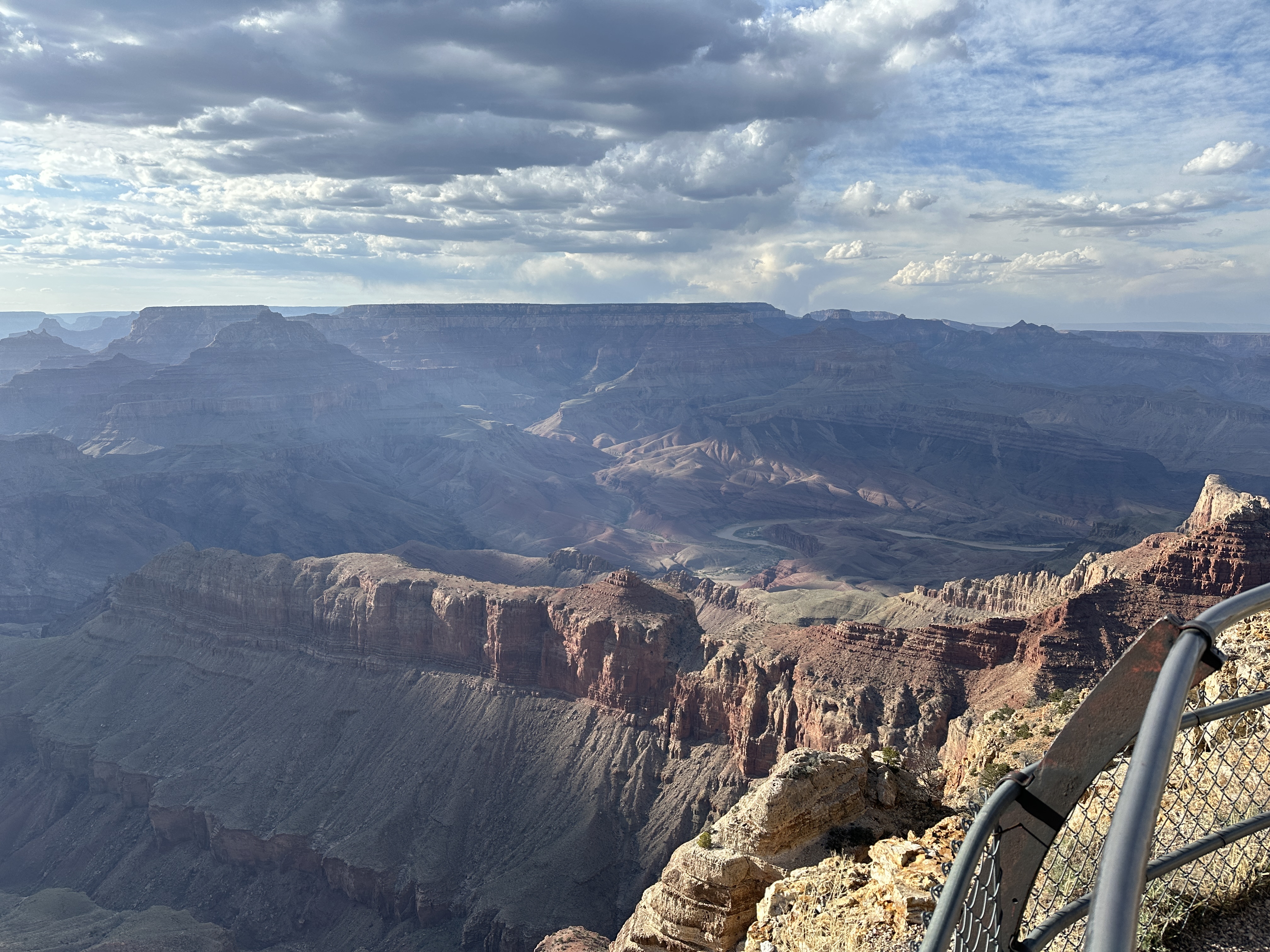
Stand at an overlook and trace the canyon walls from the rim downward. The Kaibab caps the top. The Coconino forms a pale cliff below it. The Hermit forms a slope. The Supai builds another thick interval of cliffs and slopes. Farther down, the Redwall forms one of the most recognizable cliffs in the canyon.
Two people can agree on every one of those observations.
They can agree on the names. They can agree on the order. They can agree on the physical characteristics of the rocks. They can even agree that terms such as Permian, Mississippian, and Cambrian are useful shorthand for discussing where those formations fit within the standard geological framework.
The real disagreement begins when we ask not only how much time is represented, but what processes produced the rocks in the first place.
Conventional geology places this sequence within hundreds of millions of years and interprets it through a combination of processes operating across that immense span of time, including both gradual change and episodes of catastrophe. Biblical creation works within a much shorter chronology and includes the global Flood as a unique, large-scale geological event capable of producing extensive erosion, sediment transport, burial, tectonic activity, and deposition on a scale unlike the processes we normally observe today.
So the difference is not simply “millions of years versus thousands of years.” It is also a difference in the history and mechanisms used to explain the same evidence. We are asking both how long these events took and what kind of events they were.
Using standard terminology helps make that discussion clearer. It lets us spend less time arguing over vocabulary and more time asking what happened, how quickly it happened, and what processes best account for the rocks we can actually examine.
The Names Are Useful
Good geology begins by identifying what is there before deciding what history best explains it. We want to understand the terminology, the correlations, the fossils, the structures, and the order of the rocks as carefully as possible. Then we can ask how those observations fit into a larger history.
That same approach carries into the next article, where we turn to the fossil record. Its order is real and recognizable. The question is what that order tells us about the history it records.
For Canyon Ministries, that history begins with confidence that the physical record in creation will ultimately agree with the history revealed by the Creator in His Word.