




How US Air Travel was Affected by a Grand Canyon Disaster
On June 30, 1956, Trans World Airlines Flight 2, a Lockheed L-1049 Super Constellation with 64 passengers and 6 crew members departed Los Angeles bound for Kansas City at 9:01 AM on an IFR (Instrument Flight Rules) flight plan and a planned altitude of 19,000’. Three minutes later, United Airlines Flight 718, a DC-7 with 53 passengers and 5 crew members departed Los Angeles climbing to 21,000’ bound for Chicago. The planes’ paths would cross with 2,000’ of vertical separation approximately over the Grand Canyon.
Shortly after takeoff, TWA requested permission from the TWA ground operator to ascend to 21,000’ to avoid cumulus cloud buildups. The ground operator contacted Los Angeles Air Route Traffic Control Center who denied permission stating, “You have United 718 crossing his altitude – in his way at two one thousand [21,000].” The ground operator relayed to TWA 2, “TWA Flight 2, unable to approve two one thousand.” The captain then requested “1,000 on top” (permission to fly 1,000’ above the clouds, still under instrument flight rules). This practice allowed the separation restrictions normally applied to be suspended and required the individual pilot to maintain his own separation visually from other aircraft. The controller then issued a clearance with a warning: “ATC clears TWA Flight 2, maintain at least 1,000 feet on top. Advise TWA 2 his traffic is United 718, direct to Durango, and estimating Needles, California at 9:57 am.” The ground operator relayed the clearance. TWA climbed.
In 1956, ATC radar coverage was non-existent over most of the US. Commercial airliners reported positions to controllers and estimated their time to the next position. At 10:13 am, the Salt Lake controller received the latest position reports from both aircraft. Interestingly, he knew both planes were at 21,000’, and would cross each other’s paths over the Painted Desert at the same moment, but he did not advise the airliners. According to the CAA (Civil Aeronautics Administration) rules, he was not required to as they were flying visually. As the two aircraft approached each other with TWA’s Constellation to the left of United’s DC-7, the pilots were likely maneuvering around towering cumulus clouds.
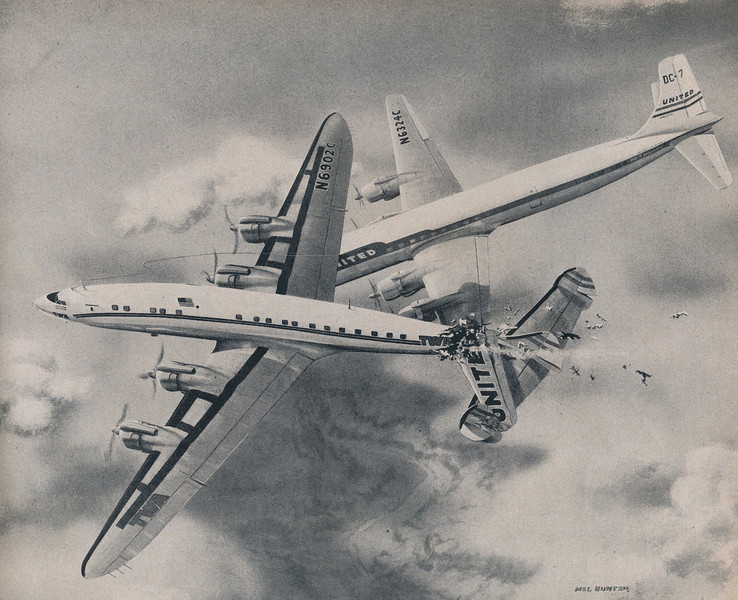 At 10:30 PST, the two aircraft struck each other over Grand Canyon National Park. The DC-7’s left wing struck the Constellation’s tail and then slid on top of the fuselage, its propeller blades slicing through the rear cabin and causing immediate loss of control to United as its tail assembly separated from the rest of the aircraft. Sixty to 90 seconds after the collision, at 10:31, the Salt Lake City controller received a garbled radio transmission from TWA First Officer Robert Harms “Salt Lake, ah, 718 . . . we are going in.” It plunged in a four-mile vertical dive to the base of Temple Butte on the north slope of the canyon at the confluence of the Colorado and Little Colorado Rivers at an estimated speed of more than 475 mph (700 feet per second), penetrating 20 feet into the sheer wall, annihilating the aircraft. A fire ensued. The tail section came to rest 550 yards north of the impact area. Light debris (such as magazines, blankets, and personal effects), fell over a large area along both banks of the Colorado River from the explosive decompression which occurred instantly at initial collision.
The impact of the DC-7’s propeller with the Constellation’s fuselage left its outer left wing panel mangled and unable to produce adequate lift and a damaged engine unable to produce power. Capt. Robert F. Shirley was unable to control the aircraft and it descended rapidly in a left spiral, crashing into the top of an 800’ sheer cliff on the south side of Chuar Butte and burned.